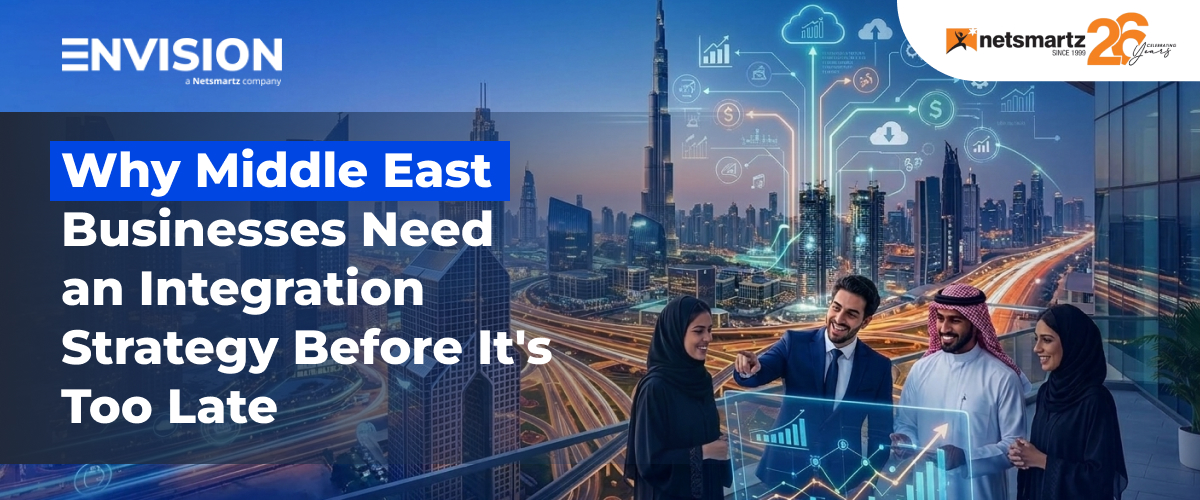
Why Middle East Businesses Need an Integration Strategy Before It’s Too Late
- 3 months
-
 Mahendra Tomer
The Middle East Is Investing Billions in Digital Transformation. But There’s a Problem.
IT spending across the MENA region is projected to reach $230.7 billion – governments, enterprises, and SMBs across the UAE, Saudi Arabia, Qatar, Kuwait, Bahrain, Oman, and Egypt are all racing to modernize.
New CRM systems. New ERP platforms. New AI tools. New customer portals. Cloud migrations. Data platforms. The investment is real, the ambition is clear, and the national mandates are in place.
But here is the problem that most businesses are not talking about: every new system you add without an integration strategy makes your business harder to run, not easier.
You end up with ten different platforms that don’t talk to each other. Your sales team can’t see what your finance team knows. Your customer service agents work from incomplete information. Your AI tools produce unreliable results because they’re drawing from fragmented, siloed data.
This is not a technology problem. It’s an integration strategy problem. And across the Middle East, it’s costing businesses far more than they realize.
The Reality for MENA Businesses in 2026
- IT spending across MENA is projected to reach $230.7 billion – the region’s largest-ever technology investment
- SMEs represent 80-90% of private sector businesses in MENA – but most lack integration expertise
- 46% of MENA CEOs identify modern data architecture as their top priority for 2026
- Digital transformation is a national strategic priority across UAE, KSA, Qatar, Kuwait, Bahrain, and Oman
- Most businesses are adding new systems without a plan to connect them – creating more silos, not fewer
What Is an Integration Strategy and Why Does It Matter?
An integration strategy is simply a plan for how all the technology systems in your business will share data with each other – in real time, reliably, and securely.
Without one, every new system you add becomes an island. Data gets duplicated. Teams work from different versions of the truth. Automations break. Customers have fragmented experiences. And when you try to deploy AI, it has no reliable data foundation to work from.
With a proper integration strategy backed by MuleSoft integration services – your entire technology stack becomes a single, connected, intelligent system that every team, every tool, and every AI agent can draw from.
Why This Is Especially Critical for Middle East Businesses
Middle East businesses face a unique combination of factors that make integration strategy more important here than almost anywhere else in the world:
| MENA-Specific Challenge | Why Integration Strategy Solves It |
|---|---|
| Rapid growth across multiple markets | UAE, KSA, Qatar operations need connected data – not three separate systems |
| Multi-language operations (Arabic + English) | Integration ensures Arabic and English data stays consistent across all platforms |
| National Vision mandates (2030/2031) | Governments expect digital-first businesses – disconnected systems fail compliance audits |
| Legacy systems still in operation | Many MENA businesses run decades-old ERP or finance systems alongside modern CRMs – integration bridges the gap |
| Multi-entity group structures | GCC holding companies with multiple subsidiaries need one connected view across all entities |
| Data residency regulations | KSA PDPL and UAE data protection laws require governed, auditable data flows – integration platforms enforce this |
| AI adoption ambitions | 46% of MENA CEOs prioritize modern data architecture – AI cannot work without integrated, clean data |
5 Signs Your Middle East Business Needs an Integration Strategy Right Now
1. Your Teams Are Working from Different Data
Your sales team sees one version of a customer record in Salesforce. Your finance team sees a different version of your ERP. Your customer service team has a third version of their support platform. Nobody trusts the data, so nobody uses it effectively.
This is the most common symptom of a disconnected technology stack, and it gets worse with every new system you add.
2. Your Digital Transformation Projects Keep Stalling
Across the Middle East, many transformation projects stall at the proof-of-concept stage – not because the technology doesn’t work, but because the underlying data infrastructure is not connected enough to support scaled deployment.
If your AI pilots, CRM rollouts, or automation projects keep hitting walls – disconnected systems are usually the root cause.
3. You’re Adding New Systems but Getting Slower
Every new platform should make your business faster. If adding a new system makes your business slower – more manual data entry, more reconciliation work, more IT maintenance – that’s a clear sign you’re building without an integration strategy.
Also Read: MuleSoft Integration for Disconnected Enterprise Systems
4. Your Customer Experience Is Fragmented
Customers across the Middle East expect seamless, personalized, digital-first experiences. If your customer service team can’t see the full history of customer interaction across all your systems – your customer experience will always feel disconnected, regardless of how good your individual tools are.
5. You’re Preparing to Deploy AI – But Your Data Isn’t Ready
This is the most urgent sign in 2026. AI tools — including Salesforce Agentforce, Einstein AI, and custom AI agents – cannot deliver reliable results on fragmented, siloed data. If your data lives in disconnected systems, your AI investment will underperform regardless of how powerful the model is.
Businesses serious about AI deployment in 2026 need to address their API layer first – learn how in our guide on MuleSoft API management for MENA enterprises.
How MuleSoft Solves the Integration Challenge for MENA Businesses
MuleSoft – Salesforce’s enterprise integration platform is the tool that connects all of this together. It acts as the central integration layer between every system in your business: your CRM, ERP, finance platform, marketing tools, customer portals, AI agents, and any external data source.
For Middle East businesses specifically, MuleSoft delivers four critical capabilities:
- Connect anything to anything – SAP, Oracle, Microsoft Dynamics, local ERP systems, government portals, payment gateways – MuleSoft connects them all through a single, governed integration platform.
- Real-time data flow – data moves across your systems in real time, not in overnight batch jobs. Every team works with current, accurate information.
- Data governance and compliance – MuleSoft enforces data residency rules, audit trails, and security policies at the integration layer – critical for KSA PDPL and UAE data protection compliance.
- AI readiness – MuleSoft’s Agent Fabric capability ensures your AI tools have access to complete, real-time data from across your entire technology stack.
For businesses already using Salesforce, MuleSoft is the native integration layer. It connects Salesforce to your ERP, finance system, HR platform, and any other tool – giving your teams a single, complete view of every customer, every transaction, and every interaction. This is the foundation that makes Agentforce and Einstein AI work reliably across the Middle East.
Where to Start: A Simple 3-Step Approach
You don’t need to integrate everything at once. The most successful MENA businesses start with a focused, phased approach:
| Step | What to Do |
|---|---|
| Step 1 – Map Your Stack | List every system your business currently uses. Identify which ones share data today and which ones don’t. This is your integration gap map. |
| Step 2 – Prioritize by Impact | Which disconnected systems cause the most pain for your teams or customers right now? Start there – not with the most complex integration, but the most valuable one. |
| Step 3 – Build for Reuse | Use MuleSoft’s API-led approach to build integrations as reusable assets. Every connection you build becomes the foundation for the next one – your integration capability compounds over time. |
The Bottom Line: The Cost of Waiting Is Higher Than You Think
Every month your systems remain disconnected, your teams make decisions on incomplete data, your customer experiences fall short, and your AI investments underperform. The cost is not just operational – it’s competitive.
Across the Middle East, the businesses that will lead their industries in 2026 and beyond are not the ones spending the most on individual systems. They’re the ones that connect those systems into a single, intelligent, integrated platform.

Frequently Asked Questions
- Is MuleSoft suitable for mid-sized businesses in the Middle East – not just large enterprises?
- How does an integration strategy support Vision 2030 and Vision 2031 compliance?
- How long does it take to build an integration strategy?
- Do we need to replace our existing systems to implement MuleSoft?
Yes – and this is a common misconception. While MuleSoft has historically been associated with large enterprise deployments, the platform has expanded significantly with more accessible pricing tiers and low-code tools. Mid-market businesses across the GCC with 5 or more connected systems are strong MuleSoft candidates, especially if they’re running Salesforce alongside an ERP or finance platform.
Both Saudi Vision 2030 and UAE Vision 2031 emphasize digital-first government and business operations, data sovereignty, and AI adoption. An integration strategy built on MuleSoft directly supports all three – enabling real-time data flows, enforcing local data residency, and providing the connected data foundation that AI adoption requires.
The strategy itself – mapping your systems, identifying priorities, and designing your integration architecture – typically takes 2-4 weeks with the right partner. The first integration can go live 4-
8 weeks from there. The key is starting with your highest-impact connection rather than trying to connect everything at once.
No – and this is one of MuleSoft’s biggest advantages for Middle East businesses. MuleSoft connects to your existing systems including legacy ERP platforms, on-premises databases, and local Arabic-language business applications. You don’t need to replace anything. You need to connect with everything.