Agentforce in the Middle East: What MENA Business Leaders Need to Know Before Deploying AI Agents
- 2 months
-
 Mahendra Tomer
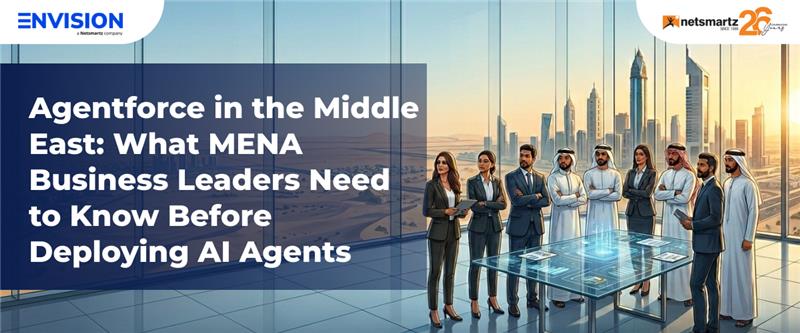
The race to deploy AI agents is accelerating across the Gulf, and Salesforce Agentforce is emerging as a key platform in that transformation. From Riyadh to Dubai, enterprises are moving beyond experimentation toward real-world deployment—using AI agents to reshape customer engagement, automate operations, and scale service delivery.
But while the opportunity is significant, successful adoption requires more than enabling a new tool. For MENA business leaders, deploying agentic AI is a strategic decision that intersects with data governance, regulatory compliance, and operational readiness.
What Is Agentforce—and Why It Matters Now
Agentforce is Salesforce’s platform for deploying autonomous AI agents that can manage customer interactions, internal workflows, and operational processes with minimal human intervention. Built to work within the Salesforce ecosystem, it leverages trusted enterprise data to deliver real-time, context-aware responses while maintaining human oversight for sensitive decisions.
What makes this moment different is the speed of enterprise adoption. In 2025, Salesforce reported a sharp increase in AI agent deployment across industries, signaling a shift from pilot programs to scaled implementation. For MENA organisations—many of which are already investing heavily in digital transformation—this represents a natural next step.
Government-led initiatives such as Saudi Arabia’s Vision 2030 and the UAE’s digital-first strategy are further accelerating this shift, creating strong alignment between national priorities and enterprise AI adoption.
The Arabic Language Breakthrough
Historically, language has been a barrier to AI adoption in the region. That is now changing.
Salesforce has introduced Arabic language capabilities within Agentforce, enabling organisations to deploy AI agents that can understand and respond in Arabic across customer service, employee support, and operational workflows.
This is a meaningful unlock for the region. Whether customers are interacting via WhatsApp, chatbots, or service portals, businesses can now handle high-volume Arabic queries at scale—without compromising on accuracy or user experience.
For sectors like government services, banking, telecom, and real estate, this significantly expands the practical use cases for AI agents.
Where Adoption Is Accelerating
Across the Middle East, early adoption is already visible in:
- Financial services → AI agents handling multilingual customer queries and service requests
- Telecom → automated service routing and issue resolution
- Government → digital service delivery and citizen engagement
- Healthcare & real estate → workflow automation and customer lifecycle management
What differentiates successful deployments is not the technology itself, but how well it is aligned with business processes and data foundations.
What MENA Leaders Must Get Right Before Deployment
1. Data Governance and Compliance Are Foundational
AI agents operate on enterprise data—and that makes compliance non-negotiable.
Regulations such as the UAE’s Personal Data Protection Law (PDPL) and Saudi Arabia’s data protection framework require organisations to carefully manage how personal data is accessed, processed, and stored.
Agentforce does not automatically enforce governance. Leaders must ensure:
- Role-based access controls
- Field-level security
- Clear data usage policies
are built into the system from day one.
2. Data Residency Is a Strategic Decision
For many organisations in the region—particularly in government, banking, and healthcare—data residency is not optional.
Salesforce has expanded its localisation capabilities, including regional data residency options for platforms like Slack. However, businesses must validate where their data will reside and how it will be processed before deployment.
This is especially critical for compliance-heavy sectors.
3. Data Quality Will Define AI Outcomes
AI agents are only as effective as the data they rely on.
Before deploying Agentforce, organisations should:
- Clean and standardise CRM data
- Remove redundant or unused fields
- Validate data structures and workflows
Without this foundation, even the most advanced AI agents will deliver inconsistent or limited value.
4. Start with a Focused Use Case
One of the most common mistakes is attempting full-scale automation too early.
High-performing organisations start with a single, well-defined use case, such as:
- Customer service query handling
- Internal HR support
- Lead qualification or routing
This allows teams to measure ROI, refine workflows, and build internal confidence before scaling.
5. AI Works Best Alongside Humans
The goal of agentic AI is not full replacement—it is augmentation.
The most effective organisations position AI agents as collaborators that:
- Handle repetitive, high-volume tasks
- Enable faster decision-making
- Free up human teams for higher-value work
Clear internal communication is critical to ensure adoption and minimise resistance.
Infrastructure Advantage: Agentforce on AWS
Salesforce’s collaboration with AWS provides enterprises in the region with a scalable and compliant infrastructure for AI deployment.
Running Agentforce on AWS enables:
- Simplified procurement and billing
- Enhanced governance and security controls
- Alignment with regional cloud and compliance requirements
Industry estimates suggest that AI could contribute tens of billions of dollars to the UAE and Saudi economies over the coming decade—making early, well-governed adoption a strategic advantage.
Final Thought
Agentforce represents more than a new capability—it signals a shift toward the agentic enterprise, where AI agents and human teams operate together to deliver faster, more intelligent outcomes.
For MENA business leaders, the opportunity is clear. But success will depend on disciplined execution: strong data foundations, clear governance, and a phased, use-case-driven approach.
Those who get this right will not just adopt AI—they will build a sustainable competitive advantage.

Frequently Asked Questions
Q: Is Agentforce fully available in Arabic?
Arabic support is currently available for key use cases such as service and employee agents, with broader capabilities expected to expand over time.
Q: Do we need to rebuild our Salesforce environment?
No. Agentforce works within existing Salesforce setups, but data quality and security configurations should be reviewed before deployment.
Q: How does it support compliance?
Salesforce provides tools such as the Einstein Trust Layer, Privacy Center, and Salesforce Shield. However, organisations remain responsible for configuring these tools in line with local regulations.
Q: What is a realistic go-live timeline?
A focused pilot can typically go live within 8–12 weeks. Larger deployments are usually phased over several months.
Q: Is Data Cloud mandatory?
No, but integrating Data Cloud enhances performance and enables more advanced use cases.