How PropSmartz AI Agents Replace Manual Real Estate Operations in GCC Enterprises
- 2 weeks
-
 Mahendra Tomer
A lead comes in after midnight for an off-plan project in Riyadh. By morning, the inquiry has passed through multiple teams, been added to separate spreadsheets, and dropped between follow-ups. A few hours later, the buyer books with another developer.
This is still happening across GCC real estate enterprises.
As projects grow larger across Saudi Arabia, Dubai, and the wider Gulf region, many developers are discovering that disconnected workflows create far bigger operational problems than expected. Enterprise real estate teams lose an average of 1–2 hours per employee, per day to manual coordination tasks alone – time that compounds into missed deals at scale.
GCC Real Estate Enterprises Are Scaling Faster Than Their Operations
The GCC real estate market has changed rapidly over the last few years.
The MENA real estate sector is projected to reach USD 799 billion by 2033, up from USD 389.7 billion in 2024, driven by Saudi Vision 2030 mega-projects, mixed-use communities in Dubai, luxury waterfront developments in Abu Dhabi, and expanding commercial portfolios across the Gulf.
At the same time, buyers and investors expect faster communication, smoother booking experiences, and more transparency across the property lifecycle.
The problem is that many firms are still relying on systems that were never built to support enterprise-scale operations.
Sales teams often work on one platform. Leasing teams rely on another. Broker communication happens through WhatsApp groups and spreadsheets. Post-sales coordination is frequently managed manually.
As inquiry volumes rise, these operational gaps become more expensive. This is one reason conversations around AI Real Estate CRM GCC platforms are growing rapidly across the region, especially as developers try to solve persistent lead conversion challenges across MENA markets.
Manual Real Estate Operations Create Delays Across The Entire Lifecycle
Most operational problems in GCC real estate do not begin during handovers. They begin much earlier.
Lead Qualification Delays
Developers across the GCC receive inquiries from property portals, broker networks, Google campaigns, WhatsApp channels, and international investor traffic throughout the day.
The challenge is no longer generating leads. The real challenge is identifying serious buyers quickly.
In many enterprise real estate teams, inquiries still depend on manual assignment and follow-up coordination. By the time someone reviews the lead, the customer may already be speaking with another developer. This is where AI-driven lead management is helping teams respond faster and prioritize serious buyers more effectively.
Fragmented Broker Coordination
Broker ecosystems across GCC real estate are growing quickly, especially in Dubai and Riyadh. But many enterprises still manage broker relationships manually – creating visibility gaps around inventory updates, commissions, lead ownership, and follow-up tracking.
Disconnected broker coordination slows the sales process even when buyer demand remains strong. To address this, many enterprises are moving toward centralized broker portals that improve visibility and streamline collaboration.
Post-Sales Communication Gaps
Operational pressure becomes most visible after booking confirmation. Customers expect updates on payment schedules, SPA documentation, construction milestones, snagging timelines, and handover coordination. But many developers still rely heavily on manual calls, spreadsheets, and email chains for post-sales management, creating inconsistent communication across teams.
Inventory Visibility Problems
Inventory movement changes constantly across large-scale projects. Units become blocked, reserved, released, or transferred throughout the sales cycle. Without centralized visibility, teams may accidentally share outdated information with brokers or buyers – a growing concern in high-volume GCC developments where sales velocity moves quickly.
Why GCC Developers Are Turning Toward Autonomous AI Agents
Enterprise developers across the GCC are now looking beyond traditional CRM systems. They want platforms capable of automating operational workflows continuously, rather than depending on manual coordination.
Instead of functioning like static workflow tools, AI agents continuously monitor operational activity, customer engagement, and pipeline movement in real time. Many enterprises are exploring structured approaches like AI deployment frameworks to implement these systems at scale.
How AI Agents Replace Manual Operational Work
The shift toward real estate operations automation is not about removing people from the process. It is about reducing repetitive operational dependency.
AI-Powered Lead Qualification
Modern AI-powered sales pipeline systems can automatically prioritize buyers based on engagement patterns, inquiry source quality, unit preferences, and response activity. Instead of manually sorting inquiries, sales teams receive clear visibility into which buyers are most likely to convert – improving response speed while reducing pressure on the team.
Broker Portal Automation
AI-enabled systems can now support real-time inventory visibility, automated commission tracking, lead ownership management, broker performance monitoring, and instant project updates – improving transparency between enterprises and their broker networks.
Predictive Risk Alerts
Instead of reacting to delays after they happen, enterprises are using predictive systems that identify operational gaps earlier – monitoring delayed payments, lead inactivity, customer dissatisfaction, handover bottlenecks, and leasing renewal risks. That level of visibility becomes especially valuable across large enterprise portfolios.
Post-Sales Management Automation
Modern post-sales automation systems help enterprises manage customer notifications, milestone updates, payment reminders, escalation tracking, and handover workflows – reducing communication gaps between departments while improving the customer experience.
Why AI-Led Operations Matter More In GCC Real Estate
Operational complexity inside GCC real estate is very different from smaller regional markets. Large developers are often managing multiple cities, mixed-use communities, international investors, broker ecosystems, leasing operations, and enterprise reporting requirements simultaneously.
Manual coordination becomes increasingly difficult at that scale. This is why enterprise real estate software GCC platforms are becoming more important across the region – shifting focus away from disconnected CRM systems toward connected operational infrastructure capable of supporting enterprise growth.
The Role Of Salesforce In Enterprise Real Estate Operations
Many GCC enterprises already operate within large Salesforce ecosystems. For enterprise developers, the larger requirement is not only automation – it is centralization. Teams need connected customer records, unified operational visibility, accurate reporting, automated communication, and faster internal coordination.
This is increasingly important across enterprise real estate operations tied to the broader digital transformation underway across the GCC.
How PropSmartz AI Agents Support GCC Enterprises
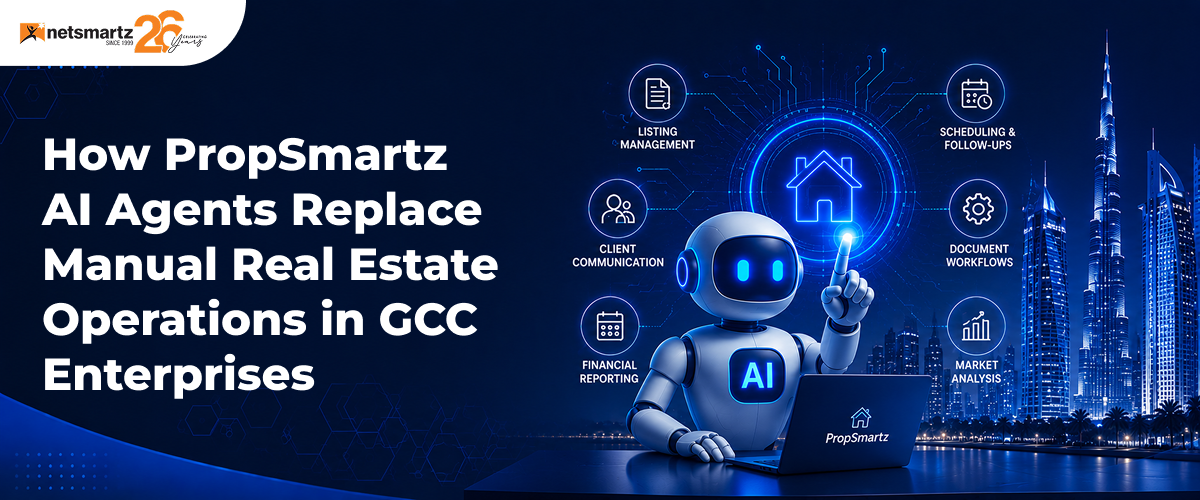
PropSmartz is not a traditional CRM with AI layered on top. It is built from the ground up around 8 autonomous AI agents that work natively within Salesforce – covering the full journey from lead to handover, 24/7.
Each agent handles a specific operational domain:
- Lead Scoring Agent – Analyzes buyer intent signals and ranks leads by conversion probability with 98% accuracy, so sales teams always know who to call first.
- Predictive Analytics Agent – Forecasts deal with closure timelines and flags at-risk opportunities before they slip, giving management time to intervene.
- Chatbot Agent – Qualifies prospects, answers queries, and books site visits 24/7 without human input – so no midnight inquiry goes unanswered.
- Sentiment Analysis Agent – Detects at-risk customer relationships weeks before cancellations or escalations.
- Pricing Agent – Recommends optimal pricing based on real-time market demand, competitor data, and lease renewal risk.
- Voice CRM Agent – Converts spoken field notes from site visits directly into structured Salesforce records, eliminating manual data entry for field teams.
- Content Generation Agent – Produces listing copy, proposals, and follow-up communications in seconds using live property data.
- Integration Agent – Keeps PropSmartz continuously synced with ERP systems, payment gateways, and legacy platforms in real time.
The larger advantage is operational continuity. For enterprises operating across Saudi Arabia, Dubai, and the wider GCC market, connected AI-driven workflows eliminate the delays that typically appear when departments work in silos, and teams have already seen results: PropSmartz clients report up to a 55% increase in team performance and a 40% increase in sales after deployment.
AI-Powered Property Management Is Expanding Across The GCC
The broader shift toward AI-powered property management systems is accelerating. Developers are no longer evaluating technology based on lead generation. They are looking at how platforms support forecasting accuracy, operational scalability, leasing coordination, customer lifecycle management, payment visibility, support automation, and enterprise reporting.
This reflects a larger change happening across the region. The conversation is no longer only about digital transformation. For many GCC enterprises, the real focus is operational efficiency at scale.
Conclusion
The GCC real estate market is growing quickly, but operational complexity is growing with it. Developers are now managing sales pipelines, broker ecosystems, customer communication, leasing workflows, payment coordination, and handovers simultaneously across large project portfolios.
That is why AI Real Estate CRM GCC platforms are becoming far more important across enterprise real estate operations. The question for GCC developers is no longer whether automation will become necessary – it is how quickly enterprises can close operational gaps before disconnected workflows begin affecting scalability, customer experience, and long-term growth.

Frequently Asked Questions
- What is an AI Real Estate CRM GCC platform?
- How do AI agents improve real estate operations?
- Why are GCC developers investing in automation?
- Can AI support post-sales and handover operations?
- Why is Salesforce important for enterprise real estate?
- Is AI becoming common in GCC real estate?
An AI-driven real estate CRM that automates sales, leasing, broker coordination, customer communication, and handover workflows across GCC enterprise operations.
AI agents reduce repetitive manual work by automating lead qualification, follow-ups, reporting, payment tracking, and operational coordination – operating continuously without manual intervention.
Large-scale projects across the GCC require better operational visibility, faster coordination, and centralized workflow management that manual processes cannot reliably deliver.
Yes. AI systems can automate milestone notifications, payment reminders, escalation tracking, and handover coordination.
Salesforce provides enterprises with scalable, centralized infrastructure for reporting, integrations, and operational continuity – making it the right foundation for AI-led real estate platforms.
Yes. Developers across Saudi Arabia, Dubai, and the wider GCC region are increasingly adopting AI-led operational systems as project scale and complexity continue to grow.