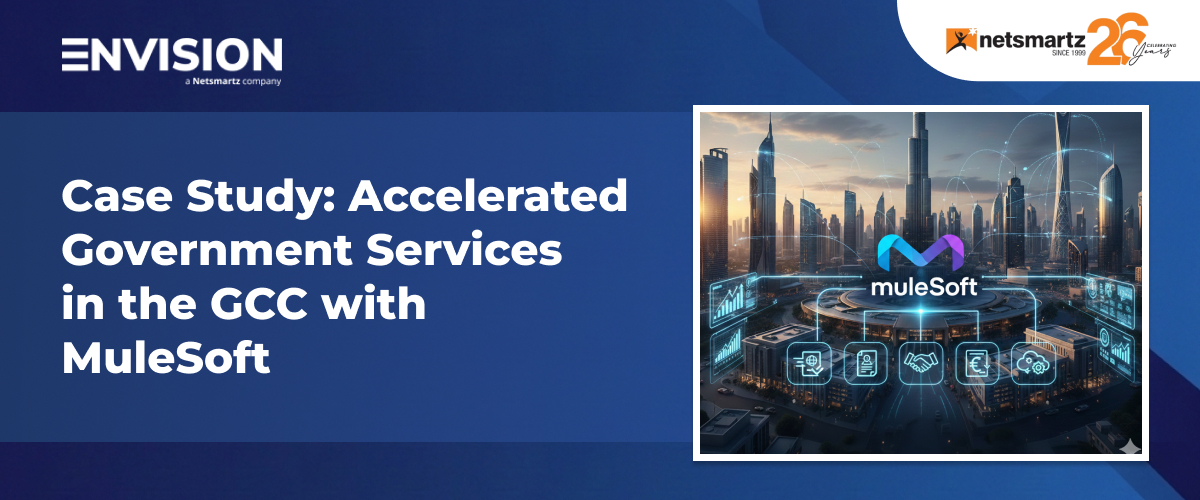
Case Study: Accelerated Government Services in the GCC with MuleSoft
- 4 months
-
 Mahendra Tomer
Executive Summary
A prominent Government entity in the Gulf Cooperation Council (GCC) region faced a critical challenge: meeting the aggressive digital service targets mandated by national transformation agendas (e.g., Saudi Vision 2030 alignment). The entity’s reliance on complex, monolithic legacy systems and manual, point-to-point integration prevented fast service launch and process automation, leading to long citizen wait times and high operational costs.
By partnering with Netsmartz and adopting the MuleSoft Anypoint Platform, the entity implemented an API-led connectivity model, creating a scalable integration framework that successfully delivered accelerated time-to-market for critical citizen services, achieved significant business process automation, and established a foundation for sustained enterprise agility.
The Challenge: Integration Crisis in Public Sector Transformation
The Government entity’s mandate was to shift 80% of citizen interactions to digital channels within two years. Key challenges hindering this goal included:
- Rigid Legacy Systems: Core identity, licensing, and records systems are reliable but inflexible. Integrating a new digital front-end requires months of fragile, custom code development per project.
- Data Silos and Fragmentation: Citizen data was dispersed across 15+ systems, making a unified, single view of the citizen impossible. This crippled the development of efficient, cross-departmental services.
- Slow Time-to-Market: The typical delivery timeline for a new digital service (e.g., a permit application) was 6 to 9 months, creating a severe digital transformation bottleneck and frustrating stakeholders.
- Compliance and Governance Risk: The lack of centralized governance over custom integrations exposed the entity to inconsistent security policies and complex audit processes.
The MuleSoft Solution: API: Led Connectivity for Public Services
(Person) worked with the Government entity to establish an Integration Center of Excellence (CoE) and implement the MuleSoft Anypoint Platform, focusing on creating reusable APIs instead of one-off integrations. The platform’s Salesforce MuleSoft integration capabilities enable seamless connectivity across citizen-facing systems and back-office operations.
Key Deployment Components
- System APIs for Legacy Modernization: We encapsulated core systems Identity, Registry, Finance) behind stable, governed System APIs. This achieved legacy system modernization without the cost and risk of core replacement.
- Process APIs for Service Orchestration: We built Process APIs to automate key processes, such as “Verify Citizen Identity” or “Process Service Application.” This enabled business process automation that could be reused by multiple digital channels.
- Governance and Security: We deployed MuleSoft’s centralized MuleSoft API management capabilities to enforce consistent security (OAuth 2.0), logging, and monitoring across all APIs, ensuring compliance with local regulations.
Quantifiable Results
The shift to the API-led model delivered immediate and transformative results, enabling the entity to meet its national mandate goals ahead of schedule.
| Metric | Before MuleSoft (Point-to-Point) | After MuleSoft (API-Led Connectivity) | Improvement |
|---|---|---|---|
| New Digital Service Launch Time | 6–9 Months | 6 Weeks | ~80% Acceleration |
| Effort to Access Citizen Data | Custom Code Per Project | API Consumption (Reuse) | 90% Reduction in Effort |
| Manual Data Handoffs | High (5+ Steps Per Service) | Near Zero (Fully Automated) | Increased Operational Efficiency |
| Integration Reusability Rate | Near 0% | Over 60% | Foundation for Enterprise Agility |
Critical Outcome: Accelerated Digital Service Delivery
The most significant ROI was the ability to rapidly launch a high-priority service: a unified digital license renewal platform.
- Point-to-Point Estimate: The IT team estimated the project would take 8 months using custom integration methods.
- MuleSoft Outcome: By reusing the newly created System APIs (Identity, Payment Gateway) and Process APIs, the team delivered the full-service platform in 6 weeks.
This accelerated time-to-market allowed the government entity to provide seamless digital customer experience and capture a significant lead in its national digital transformation ranking.
Conclusion
This case study demonstrates that for GCC Government entities to achieve their ambitious national mandates, the focus must shift from simply acquiring new applications to fundamentally modernizing the underlying integration layer. MuleSoft’s integration platform for large enterprises provides the necessary API-led architecture to:
- De-risk Transformation: By decoupling legacy core systems.
- Drive Operational Agility: By enabling rapid, repeatable service launch through API reuse.
- Ensure Governance: By centralizing security and monitoring across all citizen-facing services.
MuleSoft is the strategic enabler for Enterprise integration Middle East success.

Frequently Asked Questions
- How long does it typically take to implement MuleSoft for a government entity?
- Can MuleSoft integrate with our existing legacy government systems without requiring complete replacement?
- How does Salesforce MuleSoft integration benefit citizen-facing services?
- What security and compliance measures does MuleSoft provide for government data?
- What is the typical ROI timeline for government entities implementing MuleSoft?
- Is MuleSoft suitable for mid-sized government departments or only large federal entities?
Implementation timelines vary based on complexity, but most government entities see initial API deployments within 8-12 weeks. The GCC case study demonstrated that once the foundational System APIs were established, new services could be launched in just 6 weeks compared to the previous 6-9 months’ timeline.
Absolutely. One of MuleSoft’s core strengths is legacy system modernization through API abstraction. The platform creates a secure integration layer over existing systems (ERP, mainframes, identity management) without requiring disruptive replacements, allowing gradual modernization while maintaining operational continuity.
Salesforce MuleSoft integration creates a unified platform where citizen interactions captured in CRM systems automatically flow to back-end processing systems. This enables personalized service delivery, eliminates manual data entry, provides a 360-degree citizen view, and ensures consistent experiences across all digital touchpoints—from mobile apps to service centers.
MuleSoft’s Anypoint Platform provides enterprise-grade security including OAuth 2.0 authentication, role-based access control, data encryption in transit and at rest, centralized API governance, comprehensive audit logging, and compliance with international standards (ISO 27001, SOC 2). All API traffic is monitored and managed through a centralized control plane ensuring adherence to local regulatory requirements.
Most government entities see measurable ROI within 6-12 months. Key ROI drivers include: 80% reduction in service launch time, 90% decrease in integration development effort, elimination of manual data handoffs, and 60%+ API reusability enabling cost avoidance on future projects. The accelerated digital service delivery also improves citizen satisfaction scores and supports national transformation of KPIs.
MuleSoft’s scalable integration architecture serves organizations of all sizes. Mid-sized departments particularly benefit from the platform’s ability to accelerate digital transformation without massive IT teams. The Integration Center of Excellence (CoE) model allows smaller entities to maximize API reuse, avoid technical debt, and compete effectively with larger organizations in delivering modern citizen services.