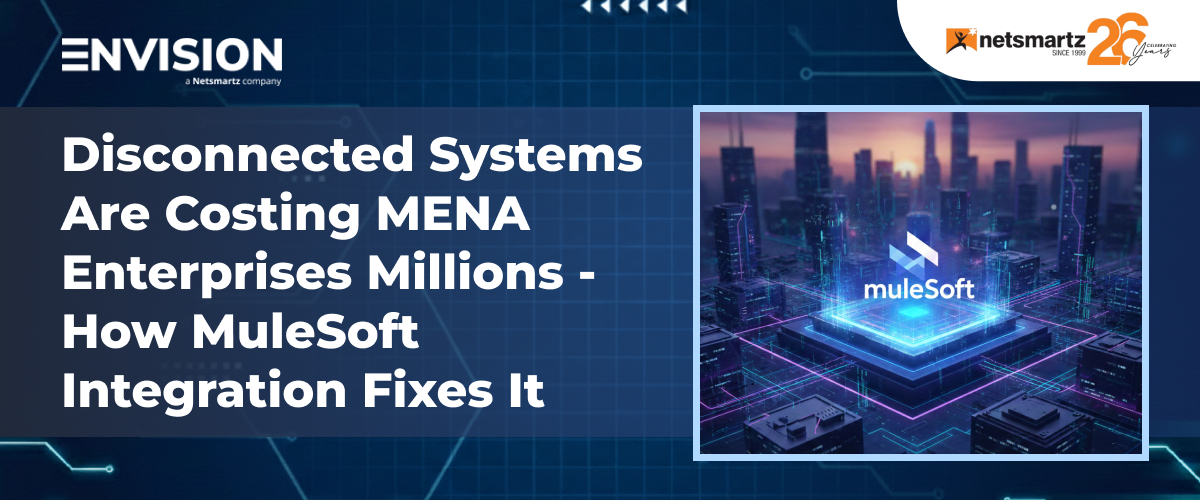
Disconnected Systems Are Costing MENA Enterprises Millions – How MuleSoft Integration Fixes It
- 4 months
-
 Sumeet Srivastava
The Middle East and North Africa (MENA) region is executing some of the most ambitious digital transformation agendas on the planet. Driven by national mandates like Saudi Vision 2030, UAE’s Operation 300bn, and similar strategies across the GCC, enterprises in finance, government, energy, and logistics are investing billions to achieve hyper-growth, modernize services, and deliver a truly digital customer experience.
Yet a fundamental, often overlooked flaw is silently sabotaging these massive investments: fragmented, disconnected enterprise systems.
This is not a technology problem; it is a critical business problem. Every time a customer’s data is inconsistent between the CRM and the core billing system, every time a new digital service is delayed by six months due to integration challenges, and every time an employee is forced to manually reconcile data across two different applications, your organization is incurring a measurable, substantial loss.
The core issue is a reliance on outdated, fragile integration methods that simply cannot keep pace with the demand for real-time data and system interoperability. The answer is a strategic shift to a modern MuleSoft Integration MENA framework.
The Financial Fallout: How Disconnected Systems Cost Millions
When systems don’t talk to each other, the resulting chaos translates directly into lost revenue, operational inefficiency, and competitive decay. Here are the three most severe financial impacts faced by large MENA enterprises due to poor enterprise system integration MENA:
1. Crippling Operational Inefficiency
Disconnected systems necessitate manual data entry, data reconciliation, and complex workarounds.
- Impact: Employees spend hours on administrative tasks instead of Value-driven work. For a major bank, calculating a consolidated customer risk profile might require manually pulling data from three separate legacy systems. For a logistics company, tracking an order might mean switching between five different screens. This lack of system interoperability bleeds time and resource bandwidth.
- The Cost: High labor costs, increased error rates, and a complete inability to achieve true business process orchestration or automation.
2. Slow Time-to-Market and Lost Revenue
Digital success today is measured in weeks, not months. The ability to launch a new mobile feature, onboard a new partner, or comply with a new regulation is dependent on fast, reliable application integration solutions.
- Impact: If launching a new product requires six months of custom, Point-to-point integration elimination coding to connect to the core ERP. A competitor who can launch in three months will capture market share and revenue. This phenomenon, often called the “Integration Gap,” stalls digital initiatives and prevents organizations from achieving the Saudi Vision 2030 alignment targets for speed.
- The Cost: Delayed revenue streams, loss of competitive advantage, and executive frustration over a widening digital transformation bottleneck.
3. Data Silos, Poor Decisions, and Customer Attrition
When core systems like CRM, ERP, and specialized industry applications (e.g., core banking, power grid management) operate in isolation, they create data silos elimination.
- Impact: A customer service agent does not have a 360-degree view of the customer. A loan officer decides based on stale data. An AI model is fed inconsistent, low-quality information, leading to flawed insights. This lack of data consolidation cripples service quality.
- The Cost: Inaccurate reporting, high customer attrition rates, and millions wasted on AI and analytics projects that fail to deliver reliable ROI. Understanding proper MuleSoft API Management is essential to preventing these costly failures.
MuleSoft Integration: The Strategic Answer to the Chaos
The solution is not more custom code; it is a fundamental architectural shift. MuleSoft’s Anypoint Platform enables API-led connectivity, a strategic approach that transforms your organization’s IT assets from a collection of fragile systems into a reusable, secure, and governable application network architecture. Salesforce MuleSoft integration services Provide the unified platform to connect CRM, ERP, and core business systems seamlessly.
MuleSoft provides the necessary data integration platform to move away from chaotic, brittle, one-off connections to a scalable integration framework that fuels growth.
1. Building the Application Network Architecture
MuleSoft eliminates the “spaghetti code” problem by structuring all integration into three reusable layers:
| API Layer | Strategic Function | Integration Benefit |
|---|---|---|
| System APIs | Unlock core systems(e.g., Mainframe, ERP, SAP) and isolate them from change. | Provides secure, governed system interconnectivity and enables legacy system modernization without costly replacement. |
| Process APIs | Orchestrates data and logic across multiple System APIs to execute a business function (e.g., “Onboard New Customer”). | Ensures consistent service orchestration and drives rapid business process automation. |
| Experience APIs | Tailors data consumption for specific channels (Mobile App, Partner Portal, AI model). | Drastically speeds up front-end and digital service development through API reusability. |
2. Unlocking Real-Time Data and Agility
By adopting this layered approach, MENA enterprises achieve immediate, quantifiable business agility:
- API Reuse: When a new project requires customer data, developers simply consume the existing, governed by “Customer Profile System API” instead of building a new connection. Our case studies show this reduces integration development time by 50% to 80%.
- Real-Time Integration: MuleSoft facilitates message-based integration and ensures real-time data synchronization across all critical business processes, providing the up-to-the-second accuracy required for modern AI and customer services.
- Seamless Hybrid Integration: The platform acts as a powerful bridge, providing the on-premises connectivity required for legacy systems while seamlessly connecting to new SaaS applications and cloud integration services (AWS, Azure, GCP). This is vital for MENA enterprises navigating data sovereignty and multi-cloud integration challenges.
3. Centralized Governance and Security
For high-compliance sectors like government and financial services in the GCC, security and governance are non-negotiable.
- MuleSoft’s centralized Integration governance ensures every API is secured, monitored, and documented from a single platform.
- The API Gateway automatically enforces security policies(like OAuth 2.0 and throttling), ensuring that sensitive data access is controlled and compliant with local regulations, eliminating the risks associated with fragmented, unsecured custom code.
Real-World Success: GCC Government Digital Transformation
For a compelling example of these principles delivering measurable results in the MENA region, explore our GCC Government Case Study where a prominent government entity achieved:
- 80% faster service delivery (6 weeks vs. 6-9 months)
- 90% reduction in integration development effort
- 60%+ API reusability rate
- Near-zero manual data handoffs
This demonstrates how MuleSoft Integration MENA frameworks directly support Saudi Vision 2030 alignment and national transformation mandates.
Your Call to Action: Stop Maintaining Pipes, Start Building an Application Network
The cost of disconnected systems in the MENA region is no longer sustainable. Investing in digital transformation without first solving the MuleSoft Integration MENA challenge is like trying to drive a luxury car with a cracked engine block—you have the vision, but not the foundation to execute the speed required.
MuleSoft is the strategic platform that provides the prebuilt connectors and robust middleware platform necessary for every large enterprise to transition from integration chaos to a high-velocity, composable business.

Frequently Asked Questions
- What is API-led connectivity, and why is it better than traditional integration?
- How does MuleSoft handle legacy systems and mainframes in the MENA region?
- Can MuleSoft support our move to the cloud while maintaining on-premises systems?
- What is the typical ROI of shifting to MuleSoft for Enterprise Integration?
- How does MuleSoft solve the problem of data inconsistency across systems?
- Do you offer support for API Governance and security compliance?
API-led connectivity is a tiered architectural approach (System, Process, Experience APIs) that treats integration as a reusable product, not a one-off project. Traditional integration usesfragile,single-use, point-to-point integration code. The API-led approach drastically increases API reusability, reduces maintenance costs, and accelerates time-tomarket.
MuleSoft uses System APIs to encapsulate legacy systems, providing a modern, secure, and governed interface to access core data. This allows organizations to achieve legacy system modernization and unlock data value without the risk and cost of replacing the stable core systems.
Yes. MuleSoft is a leading Hybrid integration MENA platform. Its runtime engine can be deployed anywhere—in local data centers for on-premises connectivity, in any public cloud (AWS, Azure, Google Cloud), or in a combination of both. This is crucial for meeting local data residency and SaaS integration requirements.
The primary ROI comes from accelerated time-to-market. By enabling developers to reuse existing Process and System APIs, new digital projects can often be delivered 50% to 80% faster than they would with custom coding, leading to significantsavingsin development and maintenance, as well asfaster revenue capture.
MuleSoft enables data transformation and data consolidation at the Process API layer, ensuring data is unified and clean as it moves between systems. This centralized data consolidation approach eliminates data silos and provides the reliable, single view of the customer necessary for high-quality service.
Absolutely. MuleSoft’s Anypoint Platform provides centralized API management and Integration governance tools, including a robust API Gateway to enforce API security policies (like OAuth and throttling) across the entire application network, ensuring strict adherence to regional compliance and audit standards.