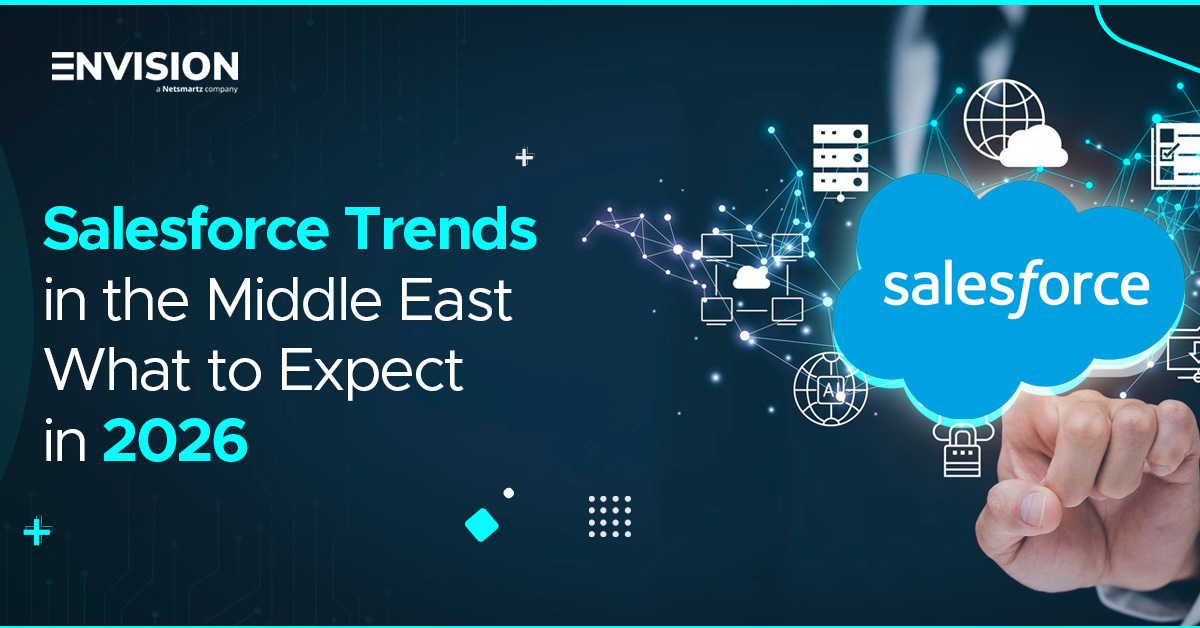
Salesforce Trends in the Middle East: What to Expect in 2026
- 8 months
-
 Sumeet Srivastava
In today’s fast-evolving business landscape, Salesforce emerges as a global powerhouse in customer relationship management (CRM) and digital transformation. Transitioning from a simple cloud-based CRM solution, Salesforce has grown into an expansive ecosystem that empowers multiple organizations. Salesforce is now the mirror of innovation, agility, and customer-centric growth.
The Middle East has always been quite popular for its ambition and forward-looking leadership. Now, it is experiencing a pivotal shift toward digital transformation. Countries such as the UAE and Saudi Arabia are accelerating initiatives like UAE Vision 2030 and Saudi Vision 2030. Both visions have one thing in common, an emphasis on technology-driven economic diversification and smarter governance.
Within this transformation agenda, Salesforce is serving as a catalyst for organizations seeking to modernize customer engagement, unify data, and drive intelligent automation.
Historically, CRM adoption in the Middle East was lagging. Even with the presence of mature markets, many organizations relied on fragmented systems or manual processes. However, now that underdeveloped state of CRM is rapidly changing.
Top Salesforce Trends Driving Growth in 2025
Whether it is banking, retail, real estate, or even the government enterprises, all are turning heads towards Salesforce to build resilience, efficiency, and customer trust.
The Middle East is embracing innovation at an unprecedented pace. Here, Salesforce’s role continues to grow both as a software provider and a strategic enabler of the digital transformation journey. Here are the key Middle East tech trends that are shaping the future of Salesforce in the Middle East:
- AI and the Rise of Agentforce
- Salesforce Data Cloud for Unified Insights
- Expanding Industry Clouds
- Salesforce and AI-Driven Digital Transformation
- Cloud Migration and Infrastructure Expansion
- The Mobile-First Momentum
- Localization and Cultural Adaptation
- Expanding the Partner Ecosystem
- Salesforce Marketing Cloud Growth
- Security, Compliance, and Trust
The Middle East is entering a new era of CRM automation with the integration of Salesforce Agentforce. Agentforce combines Einstein AI agents with real-time data to deliver autonomous and human-like customer services to all.
Whether it is financial chatbots handling multilingual queries or AI-driven service routing in telecoms, Middle Eastern enterprises use Agentforce for multiple tasks. With Agentforce in place, they can enhance responsiveness and reduce operational costs.
Salesforce AI agents & Einstein have become the key differentiator in the landscape as businesses push for hyper-customized customer engagement for service excellence.
Envision’s certified Salesforce experts can help you implement AI-driven solutions, streamline customer interactions, and drive measurable growth.
Data is the lifeblood of digital strategy. Salesforce Data Cloud empowers organizations to turn fragmented customer information into actionable insights. The tool helps in unifying data from sales, marketing, commerce, and service so that businesses can develop real-time analytics.
This allows businesses to boost loyalty and cross-sell opportunities. The financial and retail sectors in Qatar and Egypt are particularly deploying Salesforce data analytics solutions to ascertain customer needs and tailor engagement models.
The demand for Salesforce Industry Cloud in the Middle East continues to surge, particularly in retail, automobile, non-profit, and real estate industries. Industry-specific clouds from Salesforce provide localized compliance and workflow automation tools.
Governments and large enterprises are actively integrating Salesforce Industry Clouds with existing ERP systems to achieve end-to-end digital continuity, shaping an important Salesforce integration trend.
AI remains central to Salesforce digital transformation initiatives across the Gulf. Salesforce AI features enable businesses to gain the advantages of predictive lead scoring, intelligent customer routing, and beyond.
These also help them reduce response times, improve forecasting, and personalize every interaction. With the launch of Einstein GPT and Data Cloud integrations, Salesforce is helping businesses take smarter decisions and generate measurable ROI on digital investments.
A wave of Salesforce cloud migration projects is sweeping across the region. This wave is majorly driven by increased trust in local data centers and cloud infrastructure. As part of its regional expansion, Salesforce continues to strengthen partnerships with global enterprises to enhance Salesforce & cloud infrastructure in MEA.
This investment ensures high availability and low latency. Additionally, the investment is also compliant with data residency laws as it is quite critical for sectors like finance and government.
Mobile-first strategies redefine how organizations in the region engage with customers. Salesforce on mobile in the Middle East allows employees and field agents to manage customer relationships, sales pipelines, and service requests on the go. With mobile CRM adoption climbing rapidly, industries such as logistics, real estate, and utilities are gaining substantial benefits out of these.
Salesforce localization for the Middle East is becoming a strategic priority now. This includes Arabic interface options, right-to-left UI compatibility, and other culturally aligned workflows. These features help in promoting Salesforce CRM adoption and enhance inclusivity/usability for local teams.
Salesforce partner ecosystem has an emphasis on innovation, training, and localized delivery. Salesforce ecosystem partners in the UAE and Saudi Arabia are increasingly focusing on specialized services.
These include AI integration, compliance consultancy, and other sector-specific solutions. These partnerships are vital to supporting organizations through every stage of their digital journey right from design to deployment.
One of the main reasons behind Salesforce Marketing Cloud growth across the Middle East is the increase in digital commerce. Retailers and consumer brands are using it to automate omnichannel campaigns and personalize outreach through Salesforce Data Cloud.
Moreover, the tool also allows them to measure marketing ROI with precision. Combined with Salesforce AI features, this ecosystem enables businesses to understand and predict customer intent better than ever before.
With so much going on in the global landscape, Salesforce security & compliance in the Middle East has become a top concern. However, Salesforce’s strong encryption, multi-region data centers, and compliance with local data protection laws ensure customers can scale securely.
This focus on trust reinforces Salesforce’s leadership position among regulated industries like finance and government.
Conclusion
The next few years promise exponential Salesforce cloud growth in the Middle East. As AI, automation, and industry clouds mature, businesses will continue to welcome Salesforce AI CRM and Salesforce Data Cloud to achieve smarter customer engagement.
From the UAE’s smart government initiatives to Saudi Arabia’s AI-driven retail transformation, the Middle East is adopting Salesforce as a pillar of digital progress. Through a powerful combination of Salesforce AI features, cloud infrastructure, and localization efforts, the region is reshaping its economic future around the technology.
Multiple industries are opening their doors for Salesforce adoption. As industries and organizations continue their journey of Salesforce digital transformation, it’s only a matter of time that the platform’s role will go beyond CRM. It will soon underpin how Middle Eastern enterprises innovate, compete, and deliver exceptional customer experiences in the years to come.

Frequently Asked Questions
- What is driving Salesforce adoption in the Middle East?
- How is Salesforce contributing to digital transformation in the region?
- What are the key Salesforce trends to watch in 2025?
- How is Salesforce transforming the Middle East and Africa (MEA) region?
- What challenges and opportunities does Salesforce face in the MEA region?
Salesforce adoption in the Middle East is driven by national digital transformation programs such as UAE Vision 2031 and Saudi Vision 2030. These programs prioritize technology-led economic diversification. Organizations are embracing Salesforce CRM for its AI-powered automation, cloud scalability, and ability to deliver personalized customer experiences across industries like finance, retail, real estate, and government.
Salesforce plays a pivotal role in regional digital transformation by providing cloud-based solutions such as Salesforce Data Cloud, Marketing Cloud, and Industry Cloud. These tools enable businesses to unify customer data, automate workflows, and leverage Salesforce AI CRM capabilities.
Top Salesforce trends in 2025 include the rise of Salesforce Agentforce and AI-driven automation, growth in Salesforce cloud migration, expanded use of Salesforce Data Cloud for analytics, and a focus on localization for Arabic-speaking users. Additionally, the Salesforce partner ecosystem is expanding rapidly across the UAE and Saudi Arabia, that support innovation and implementation at scale.
Salesforce is driving digital transformation across MEA, especially in the UAE and Saudi Arabia. The UAE leverages it for smart government services and startups, while Saudi Arabia’s Vision 2030 uses Salesforce to power large-scale innovation and customer-centric growth.
Key challenges that Salesforce faces in MEA include integrating Salesforce with legacy systems and addressing talent shortages in implementation and analytics. However, these hurdles create opportunities for job growth, skill development, and government-academic partnerships to build a strong, Salesforce-trained digital workforce.