What Are Autonomous AI Agents and Why Real Estate Teams Cannot Ignore Them in 2026
- 2 weeks
-
 Sumeet Srivastava
Real estate teams are handling more leads, more platforms, and faster buyer expectations than ever before. A recent study by InsideSales showed that responding to leads within five minutes can increase conversion chances by nearly 9 times compared to delayed responses. At the same time, buyers now expect instant communication, digital scheduling, and quick follow-ups across every stage of the property journey.
That pressure is one reason AI agents for real estate teams are becoming a serious industry discussion in 2026.
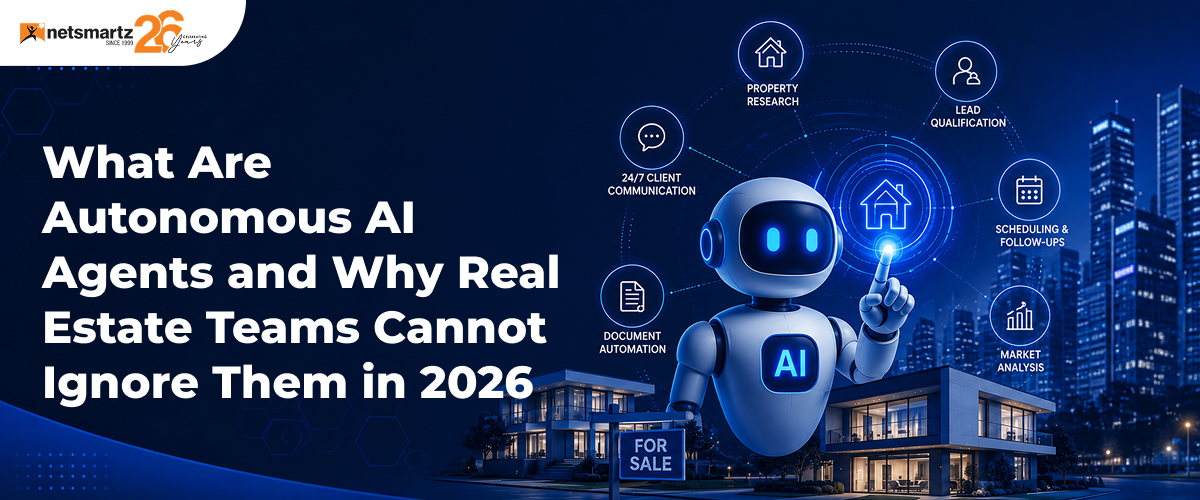
Unlike basic automation tools, autonomous AI systems do more than follow instructions. They monitor activity, identify patterns, prioritize opportunities, trigger actions automatically, and help teams make faster decisions without constant manual supervision.
For developers, brokers, leasing teams, and channel partners, the shift is becoming difficult to ignore.
Why Real Estate Workflows Started Breaking Down
Real estate operations have become heavier during the last few years. Sales teams handle leads from dozens of platforms. Leasing teams answer inquiries late into the evening. Post-sales departments manage complaints, payments, and handovers all at once. Most of the pressure comes from volume rather than complexity.
A manager may still use spreadsheets. Another team may depend on calls and reminders. Yet buyers now expect replies within minutes, not days. Missed follow-ups turn into lost opportunities.
This is where real estate AI automation 2026 discussions began gaining attention. Businesses realized the problem was not a lack of staff. The real issue was that employees were spending too much time chasing information manually – losing an average of 1-2 hours per person, per day to coordination tasks that could be automated. Many teams are now rethinking how lead capture and nurturing can be automated within their workflows.
Real Estate Chatbots vs Autonomous AI Agents
Many people still confuse a chatbot with an AI agent, but the difference is becoming important for modern property businesses.
| Traditional Chatbot | Autonomous AI Agent | |
|---|---|---|
| How it works | Reacts only when a user sends a message | Monitors activity continuously and acts proactively |
| Intelligence | Follows predefined, fixed workflows | Learns from patterns and buyer behavior |
| Follow-up | Requires manual triggers | Triggers actions automatically |
| Timing | Reacts after something happens | Predicts issues before they become visible |
| Scope | Handles isolated queries | Coordinates across departments end-to-end |
A simple example:
A chatbot answers pricing questions for a residential project.
An AI agent notices that the same buyer has repeatedly visited premium inventory pages, opened payment-plan documents multiple times, and responded quickly to WhatsApp messages.The system automatically prioritizes the lead, notifies the sales manager, and schedules a site visit – without anyone having to ask it to.
That difference is exactly why real estate AI automation 2026 conversations are accelerating.
AI Agent Use Cases Already Appearing Across Real Estate
Many companies are already testing AI-powered real estate software even if they are not describing it publicly as autonomous AI.
The biggest change is happening in operational workflows that traditionally consume large amounts of manual effort.
1. Lead Qualification and Routing
Sales teams often lose valuable time sorting inquiries manually.
Modern systems now analyze buyer intent signals, property preferences, ad engagement, budget ranges, and inquiry timing to identify high-conversion opportunities.
This type of AI lead management real estate workflow helps teams prioritize serious buyers instead of spending equal effort on every inquiry – especially when connected to a structured CRM-led sales and handover process.
According to Salesforce research, sales teams using AI-supported CRM workflows report productivity improvements of nearly 30%.
2. Channel Partner and Broker Management
Large developers frequently coordinate with multiple brokers and channel partners across projects.
AI systems can automatically match brokers with suitable inventory, track response quality, recommend commission opportunities, and monitor underperforming channels.
This reduces delays in inventory movement and improves partner coordination.
3. Automated Follow-Up and Site Visit Coordination
Many property buyers now expect immediate responses.
If a lead waits several hours for a callback, interest often disappears.
Using real estate sales automation tools, businesses can automate reminders, callback scheduling, WhatsApp responses, proposal generation, and AI-driven site visit scheduling.
The process feels smoother for both buyers and sales teams.
4. Payment Tracking and Post-Sales Handover
Post-sales coordination creates operational pressure for many developers.
Payment reminders, documentation follow-ups, handover schedules, and customer complaints are often managed manually.
With AI in real estate operations, systems can identify delayed payments, detect customer frustration through sentiment analysis, and alert teams before issues escalate – particularly when workflows are aligned across a lead-to-handover lifecycle on Salesforce.
5. Leasing and Renewal Management
Leasing teams are also adopting predictive systems.
AI models now estimate tenant renewal probability using support history, occupancy patterns, payment behavior, and communication activity.
That allows teams to act earlier instead of waiting for tenants to leave unexpectedly.
Why Real Estate AI Adoption Is Accelerating in 2026
The market itself is changing rapidly.
Buyers search digitally before speaking with agents. Investors compare multiple projects simultaneously. Leasing inquiries arrive through websites, WhatsApp, social media, broker networks, and property portals all at once.
A report from HubSpot found that nearly 90% of customers expect quick responses when contacting businesses online. That expectation now applies strongly to real estate.
This creates pressure on teams already managing:
- inventory allocation
- broker coordination
- payment tracking
- lead nurturing
- post-sales handovers
- leasing renewals
- CRM updates
Many businesses are discovering that manual coordination no longer scales efficiently. Another important shift is accessibility – AI tools are no longer limited to massive enterprises. Mid-sized developers, brokerages, and leasing firms can now adopt scalable proptech AI solutions without rebuilding their entire technology stack.
Common Challenges When Implementing AI in Real Estate
Despite growing adoption, implementation is not always simple.
Some businesses struggle because technology is introduced without fixing operational problems first.
Common challenges include:
Poor CRM Adoption
If sales teams avoid updating records, AI systems receive incomplete information and scoring accuracy drops.
Fix: ensure CRM usage is embedded into daily team workflows before AI layers are introduced.
Bad Data Quality
Duplicate leads, outdated inventory data, and missing payment records reduce prediction accuracy significantly.
Fix: run a data audit and cleansing process before going live with any AI system.
Employee Resistance
Some teams worry that automation may replace jobs. In reality, most systems are designed to reduce repetitive work rather than replace relationship-building roles.
Fix: involve teams early, show them how AI removes admin burden rather than replacing their value.
Over-Automation
Too many automated messages can make communication feel robotic and damage customer relationships.
Fix: define clear boundaries – automate coordination and reminders but keep critical conversations human-led.
Integration Problems
Disconnected ERP systems, accounting software, and legacy CRMs often slow implementation and create data gaps.
Fix: prioritize platforms built around connected workflows and native integrations rather than isolated automation features bolted onto existing tools.
How PropSmartz AI Agents Are Built for This Shift
As more developers and brokers explore automation, attention is moving toward platforms that combine CRM workflows, predictive intelligence, and operational automation inside one ecosystem.
PropSmartz – built natively on Salesforce and developed by Netsmartz – is designed specifically around this operational reality.
Rather than offering AI as an add-on feature, PropSmartz is built from the ground up to 8 autonomous AI agents, each handling a specific real estate function continuously and independently.
Here is how each agent directly addresses the workflows real estate teams struggle with most:
| AI Agent | Function | What It Replaces |
|---|---|---|
| Lead Scoring Agent | Ranks leads by conversion probability at 98% accuracy using intent signals | Manual lead sorting and guesswork prioritization |
| Predictive Analytics Agent | Forecasts deal closure timelines and flags at-risk opportunities early | Reactive deal reviews after opportunities have already slipped |
| Chatbot Agent | Qualifies prospects, answers queries, and books site visits 24/7 | After-hours missed inquiries and delayed first responses |
| Sentiment Analysis Agent | Detects at-risk customer relationships weeks before they escalate | Manual check-ins and surprise cancellations or complaints |
| Pricing Agent | Recommends optimal pricing using real-time demand and competitor data | Static pricing decisions made without live market context |
| Voice CRM Agent | Converts spoken field notes into structured Salesforce records automatically | Manual data entry after site visits, reducing record accuracy |
| Content Generation Agent | Produces listing copy, proposals, and follow-ups using live property data | Hours spent on manual content and proposal preparation |
| Integration Agent | Keeps PropSmartz synced with ERP, payment gateways, and legacy systems in real time | Data gaps caused by disconnected platforms and manual transfers |
Because PropSmartz is built natively on Salesforce – not simply integrated with it – all 8 agents operate within the same connected data environment. Sales, leasing, broker management, post-sales, and customer service teams work from one unified platform with no silos between departments.
For developers managing multiple cities, international investors, and large property portfolios simultaneously, this level of connected automation allows operations to scale without proportionally growing headcount.
The Human Side of AI Adoption
One common fear around automation is that employees will become less important. In reality, most property businesses adopting AI are using it to remove repetitive work rather than replace relationship building.
Agents still negotiate deals. Leasing teams still manage conversations. Managers still make strategic calls.
A sales representative spending four hours updating records every day has less time for buyers. AI systems reduce that friction by handling repetitive coordination in the background.
That is why many discussions around prop-tech AI agents focus less on replacement and more on operational relief.
What Happens If Teams Ignore the Shift?
Ignoring technology does not always create immediate problems. Sometimes businesses continue operating normally for a while.
- Lead response times become inconsistent
- Sales reporting becomes delayed
- Customer frustration increases
- Staff burnout grows
- Competitors close deals faster
By the time leadership notices the impact, recovery becomes harder.
That is why conversations around real estate digital transformation 2026 have become more practical than theoretical. Companies are no longer asking whether automation matters. They are asking how quickly they can implement it without disrupting operations.
Questions Real Estate Leaders Should Ask Before Choosing an AI Platform
Before investing in any system, teams should evaluate operational needs carefully:
- Does the platform integrate natively with your existing CRM, or does it bolt on top of it?
- Can workflows be customized per department – sales, leasing, post-sales, broker?
- Does the AI explain why it makes recommendations, or does it operate as a black box?
- How much manual supervision is still required after go-live?
- Will employees actually use the platform in their daily workflow?
- Can the system scale across new projects and markets without a rebuild?
These questions matter because software adoption usually fails when platforms feel disconnected from real work patterns.
Conclusion
The property industry has always moved carefully when it comes to technology. Yet every few years, something arrives that slowly changes how everyday work gets done. Autonomous AI agents appear to be one of those changes.
They are not replacing human relationships or turning real estate into a fully automated business overnight. Instead, they are helping teams reduce repetitive work, improve response times, organize operations better, and focus more attention on buyers and tenants.
For developers, brokers, leasing specialists, and operations managers, the bigger challenge in 2026 may not be adopting AI too soon. The real challenge could be waiting too long while competitors quietly improve speed, coordination, and customer experience through smarter systems.

Frequently Asked Questions
- What is an autonomous AI agent in real estate?
- How does automated lead follow-up help real estate teams?
- Can AI help with site visit scheduling?
- Is AI expensive for real estate businesses?
- Will AI reduce operational mistakes?
- What should companies check before choosing an AI platform?
A system that continuously monitors activity, analyzes patterns, and triggers actions automatically – without manual instructions. Unlike a chatbot, it works proactively across lead management, broker coordination, post-sales follow-ups, and more.
It keeps conversations active, sends timely reminders, and routes serious buyers to the right team member – preventing leads from going cold due to delayed responses.
Yes. AI automates appointment coordination, confirmations, reminders, and rescheduling – cutting the back-and-forth that typically delays bookings.
It depends on the platform and scale. Enterprise solutions like PropSmartz are built to grow with your operations, making them viable for mid-sized and large teams alike.
Yes. It significantly reduces delays, missed follow-ups, and data gaps across post-sales coordination, broker management, and payment tracking.
Evaluate CRM integration, workflow flexibility, data security, reporting quality, and whether the system can execute tasks autonomously – not just surface recommendations.